
GED
GED Fast Track Program
Direct GED preparation for students ready to move forward.

Program Overview
Not every student needs academic rebuilding. Some students already have the foundation they need and are ready to focus directly on passing the GED.
The GED Fast Track Program is designed for students who are academically prepared and want a structured, performance-driven pathway toward GED completion.
This is not a foundation program. This is direct GED preparation.
Every lesson, assessment, practice session, and readiness checkpoint is designed around one objective: passing the GED and progressing toward the next stage of a student's educational journey.
Our goal is not to place students into the fastest program. Our goal is to place them into the right program.
Who Is This Program For?
Why Students Fail the GED
Most GED failures are not caused by a lack of effort. They are often caused by weak reading stamina, poor time management during exams, inconsistent practice, weak mathematical reasoning, difficulty interpreting evidence, graphs, and data, lack of exposure to GED-style questions, and taking the exam before true readiness is achieved.
Many students spend months studying without understanding how the GED is actually assessed. The result is repeated failures, expensive retests, delayed university plans, and loss of confidence.
At ELS, preparation is structured around performance, not guesswork.
What Makes ELS Different?
Many GED programs focus on completing a textbook. We focus on readiness.
Students do not progress because they finish lessons. Students progress because they demonstrate measurable performance under GED-style conditions.
Every student receives structured GED curriculum, timed practice every week, GED-style assessments, error tracking systems, performance monitoring, academic intervention when required, and readiness reviews before testing approval.
This creates accountability, consistency, and a clearer pathway toward successful GED completion.
What Students Will Master
Reasoning Through Language Arts (RLA): students develop reading comprehension, evidence-based analysis, vocabulary development, critical reading skills, constructed response writing, extended response preparation, and GED-level reading stamina.
Mathematical Reasoning: students strengthen algebra, equations and inequalities, quantitative reasoning, geometry concepts, data analysis, calculator proficiency, and multi-step problem solving.
Science: students learn to interpret scientific information, analyze graphs and data, evaluate evidence, understand experiments and variables, and apply scientific reasoning.
Social Studies: students build the ability to analyze sources, interpret maps and charts, understand civics and government concepts, evaluate historical and economic information, and apply evidence-based reasoning.
Built for Real Exam Performance
The GED is not simply a knowledge test. It measures how effectively students can think, analyze, interpret, and perform under time pressure.
That is why timed performance is built into the program from the beginning.
Students regularly complete timed reading exercises, timed mathematics sets, GED-style practice sections, mixed-subject assessments, mock examinations, and readiness benchmarking.
This helps students develop the confidence and stamina required for official testing.
Progress Is Measured
Every student is monitored through weekly assessments, homework compliance, attendance reviews, error tracking systems, reading performance analysis, mathematics performance analysis, timed practice results, and readiness checkpoints.
Families receive clear academic feedback throughout the program.
Official GED Readiness Matters
One of the most important principles at ELS is simple: not every student should take the GED simply because they want to.
Students must demonstrate readiness before official testing is recommended.
This protects students from avoidable failures, unnecessary retest costs, academic frustration, and delayed educational plans.
Our responsibility is not to send students to exams. Our responsibility is to send students when they are ready.
What Success Looks Like
Students who successfully complete the Fast Track Program should be able to handle GED-level reading passages confidently, solve GED-style mathematics problems independently, interpret graphs, charts, and evidence accurately, write evidence-based responses, manage timed testing conditions effectively, and demonstrate readiness for official GED examinations.
The Goal: GED Completion and Progression
The GED is not the destination. It is the bridge.
For many students, successful GED completion leads to university applications, degree pathways, career progression, international education opportunities, and greater academic confidence and independence.
The Fast Track Program is designed to help students reach that next stage as efficiently and responsibly as possible.
Start With an Assessment
Every student begins with an Assessment & Placement Evaluation.
This evaluation identifies academic readiness, English proficiency, learning strengths, learning gaps, and the recommended pathway.
At the end of the assessment, families receive a clear recommendation based on evidence and academic readiness.
Ready to Start Your GED Journey?
Book an Assessment & Placement Evaluation and discover whether the GED Fast Track Program is the right pathway for you.
Structured Pathways. Managed Progress.
GED Programs
Other GED Courses
Explore related GED pathways designed for different levels of readiness, support, and university progression goals.

GED
GED Foundation
16 weeks academic rebuilding program
Know more →
GED
GED Pathway
Structured GED and university pathway support
Know more →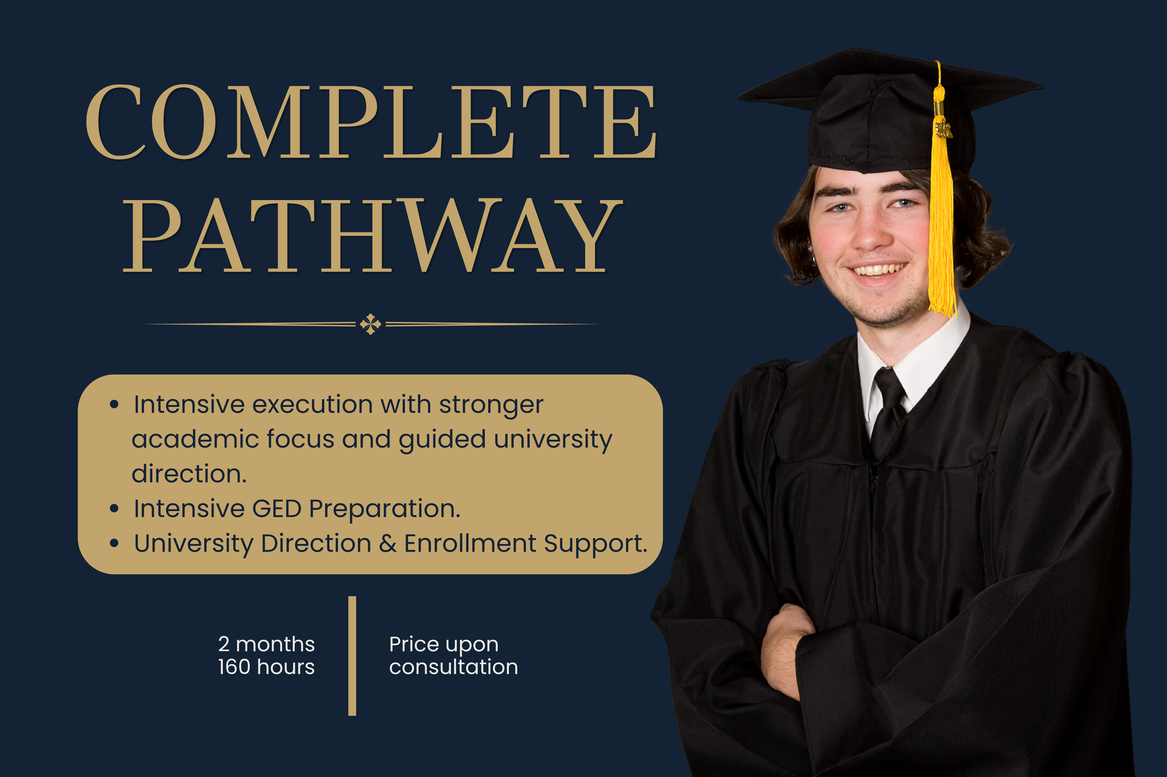
GED
Complete Pathway
Comprehensive academic and university preparation pathway
Know more →
GED
Complete Pathway Plus
Extended pathway support for stronger academic readiness
Know more →